Tuesday, March 15, 2011

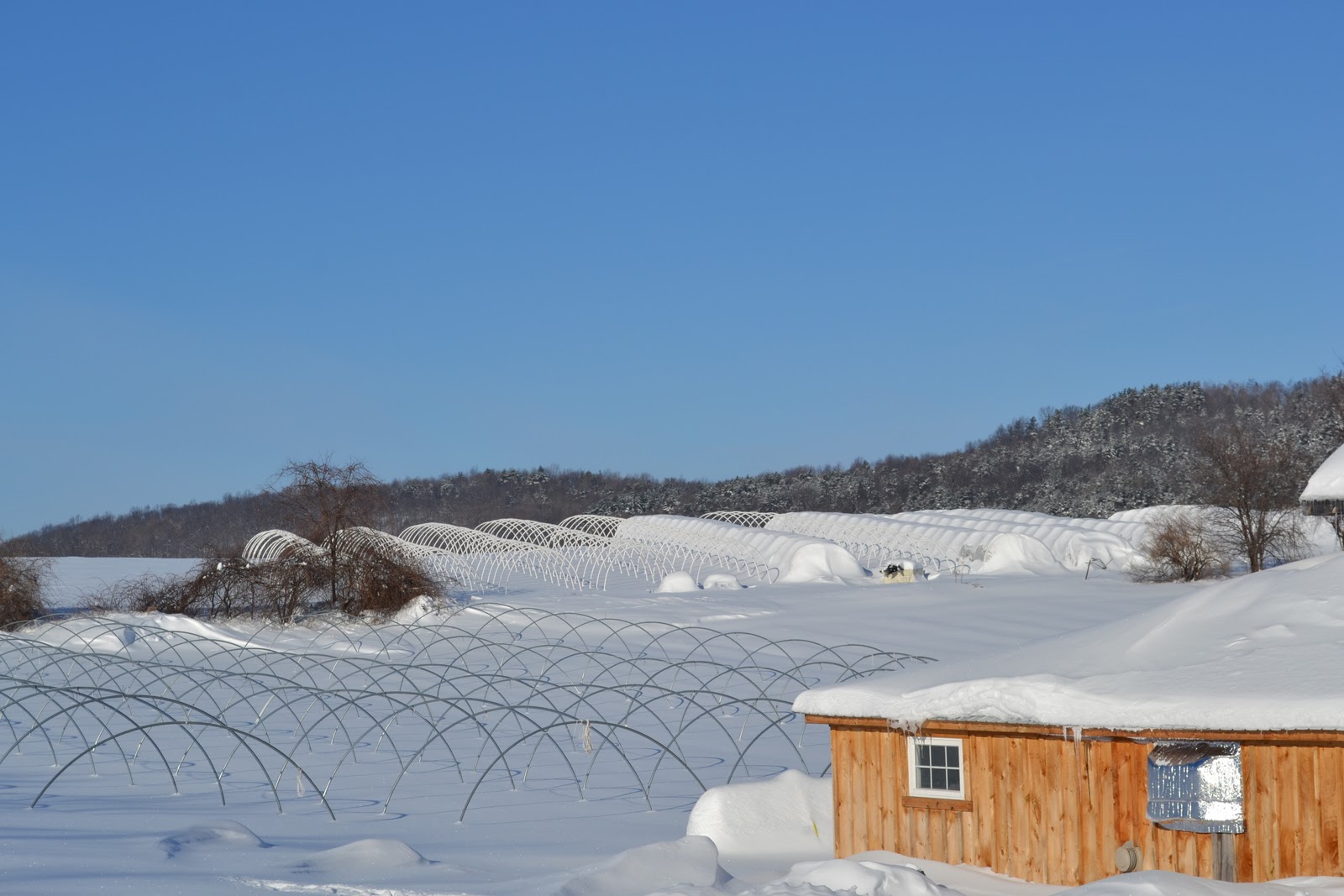
Johnny's Winter Caterpillar Tunnel Structural Trial

Goal: To see if either caterpillar tunnel version (with, or without purlins) could withstand winter snowload.


Results: Were very interesting. We picked two of the four tunnels that were built in May, 2010, actually planted onions in them, and buttoned them up for the winter. Both tunnels were structurally the same, with a center ridge-pole made of chain link fence top-rail, but one of them also had purlins about three feet from either side of the ridge. These purlins in summer, were used to trellis vine crops, and carried that load quite well. They really stiffened up the whole structure. However, in summer, they tended to cause the plastic to collect rainwater. This made me think that the purlins would either make it so strong that it would better carry the snow load or they would catch more snow than the tunnel without purlins and cause a collapse. It looks like the latter is the case.


Summary and recommendations: It is important to note that we intentionally did not remove snow in this trial, as we were looking for structural failure in worst case conditions. Removal of snow even just next to the tunnel that failed probably would have prevented its failure, because the pressure bearing in on the sides (and therefore the plastic's weight felt on the top) would have been greatly reduced. If you intend to use a structure like this to overwinter crops in northern climates where snowfall is a concern, I would recommend a maximum of four foot bow spacing during construction, not using side purlins in winter tunnels because they catch snow, and of course the removal of snow whenever possible from the sides and top of the tunnel. It would also be prudent to shore up the bows internally with notched two-by-fours placed vertically under every other bow as a means of additional snowload insurance and peace of mind.
 The 26-page illustrated manual for the bender used to make these tunnels and an MS Excel cost calculator spreadsheet may be downloaded on the bender's product page here.

You can view the complete gallery below.


Thanks!

Adam.

Adam Lemieux
Tools & Supplies Manager

Monday, January 24, 2011

Winter High Tunnel Production at Pleasant Valley Farm

On January 24th, John Dillon and I stopped at Pleasant Valley Farm in Argyle, NY and visited with Paul and Sandy Arnold. We were given a tour of their beautiful farm and also graciously invited for lunch. Paul and Sandy are on the leading edge of farming technology and they regularly speak at conferences with venues such as NOFA NY, NOFA VT, and MOSES. They own three Rimol houses and they were recently featured on Rimol's site under their "Customer Spotlight" section. It is a very informative write up of their operation. You can view that article here:
http://www.rimolgreenhouses.com/pleasantvalley.php


When we got there, Paul gave us a tour of their two completely unheated 144 foot long Nor'Easter high tunnels which they were currently doing a winter greens production in. They have a Davis weather station that they use to monitor the tunnel temperatures from their kitchen, so they can manage floating row cover removal and replacement for optimum light exposure. They were also doing a trial of nine different spinach varieties to determine the best performer for winter production.


After lunch, they showed us the rest of the farm, which started with the packing shed. On one end of the shed, they have a spot for offloading their harvest cart right into a barrel washer. They evidently have the first production model barrel washer from Grindstone Farm. In their main washroom that is only used in summer, they have a washing tank with an air agitation system, powered by a jacuzzi air pump, and stainless packing tables on two sides. The barrel washer also feeds into this room. Nice setup. Other parts of the packing shed included a controlled cold storage area, a root cellar, a tool shed, and their winter washroom / packing area.


The packing shed led into their Rimol 30' x 60' Matterhorn seedstarting house. They were running preheated water through swimming pool solar panels as a radiant heat source for their seed starting benches and they were also using rigid Winstrip seedling trays extensively.


The last stop was their new pole barn at the lower end of the property. The had of course much of their farm equipment and tractors here, but also had one enclosed garage like area for extra cold storage.


You can view the complete gallery here:


There are also a great many photos of their operation on their facebook page.
http://www.facebook.com/pages/Pleasant-Valley-Farm/242214617771


Thanks!

Adam.

Adam Lemieux
Tools & Supplies Manager

Caterpillar Tunnels at Windflower Farm

January 24, 2011 - On the last day of our NOFA NY Winter Conference trip, John Dillon and I visited Jan & Ted Blomgren at Windlflower Farm in Valley Falls, NY – between the Hudson River and the Vermont border. They run a diversified farm that distributes produce and flowers through several CSAs in NY City.
http://www.localharvest.org/windflower-farm-M10244

My interest there was mainly their expertise in protected cropping systems, specifically the use of caterpillar tunnels.


What's a caterpillar tunnel? It's a high tunnel, generally intermediate in size between a low tunnel and greenhouse that is constructed in such a way (usually with rope overlacing) as to create a segmented appearance similar to a caterpillar. They are also called walk-in tunnels, because with most designs, you can walk in at any point along the tunnel.


A former advisor to Cornell Cooperative Extension, Ted co-authored the High Tunnels manual, which I referred to extensively when planning the construction of caterpillar tunnels at our research farm in Albion, ME in June, 2010. They have done some amazing work at Windflower Farm. Ted took us for a tour of the caterpillar tunnels. It was sunny, but -15F and the snow was deep. Since Ted was going to be giving a talk at the MOSES conference that included a segment on low tunnels, we brought him one of each of our Quick Hoops Benders and went through the bending procedures inside one of his greenhouses.


Our hosts then invited us in for coffee and cake before we headed off for our next stop - Pleasant Valley Farm.

You can view the complete gallery below.


Thanks!

Adam.

Adam Lemieux
Tools & Supplies Manager

Saturday, January 22, 2011

Winter Production at Slack Hollow Farm

While at the NOFA NY Winter Conference, I attended an offsite session one winter high tunnel production held at Slack Hollow Farm in Argyle, NY. Slack Hollow Farm is a family run diversified vegetable farm, in business since 1985. Seth Jacobs, Martha Johnson and crew grow and market NOFA-NY Certified organic produce grown in the fertile upland hills of Washington County.
http://www.slackhollowfarm.com/


Winter production: Slack Hollow Farm markets their produce year round. Through the use of two minimally heated hoop-houses that they recently added, they are able to offer a diversity of greens at several winter markets, including the Troy Farmers' Market, Saratoga Farmers' Market, Honest Weight Food Co-op, Gardenworks, and the Greenwich Local Market.


They grow arugula, baby spinach, basil, beans, beets, butternut squash, carrots, chard, cilantro, cucumbers, dill, fennel. Lettuce, kale, mesclun, mint, new potatoes, onions, oregano, parsley, purplette onions, scallions, shiitake mushrooms, and tomatoes. They also produce honey and granola.


Their high tunnels are Rimol Nor' Easters with buried radiant heat produced by oil furnaces. They try to strike a balance between the cost to provide this heat and keeping the soil just warm enough to allow plant growth. Beds are covered by three layers of row cover, suspended 1.5 ft above the crops by large horizontal EMT pipes, that is rolled up during the day to allow the crops to absorb sunlight and replaced in the evening for protection.


As a rule, Seth said they plant into 'stale' beds by leaving them fallow for  acouple weeks, and flame weeding before planting.

.
Seth is a big fan of the Four-Row Pinpoint Seeder. They own two of them, marked A & B, and they never adjust the seed hole size.


There are many other interesting things to see in the following gallery.


Thanks!

Adam.

Adam Lemieux
Tools & Supplies Manager